
What Is Abrasive
An abrasive is a material of a certain hardness and density that allows other materials to be processed by removing the material itself. For example, one of the most common operations that can be done with abrasives is the polishing of a surface or the polishing of the same.
Why Choose Us
Rich Experience
Ningbo Dahua Grinding Wheel Co., Ltd. is a well-known Chinese company specializing in researching and producing resin abrasive products. It was founded in 1996 and mainly produces fiber-reinforced resin cutting and grinding wheels, rail cutting and grinding wheels, ordinary resin grinding wheels, fiberglass, etc.
Accept ODM/OEM Service
Based on many years of accumulated industry insight, production experience, innovation capability, and a service network in the abrasive industry, the company can not only offer high-quality customized products but also collaborate with other factories to research, design, and select new materials for new products.
Quality Control
The company has passed the ISO9001 Quality Management System certification and has a comprehensive quality assurance system. The equipment is advanced and reliable. It also has complete raw material inspection, finished product inspection centers, and a quality assurance team to ensure product stability.
-

Useful Blasting Abrasives
Outside Diameter: 180 Add to Inquiry -
Standard Ceramic Abrasive
Outside Diameter: 100 Add to Inquiry -
Useful Sanding Abrasives
Outside Diameter: 180 Add to Inquiry -
Fine Metal Abrasive
Outside Diameter: 180 Add to Inquiry -
Useful Glass Bead Abrasive
Outside Diameter: 180 Add to Inquiry -
Multi Use Glass Abrasive
Outside Diameter: 180 Add to Inquiry -
Portable Abrasives for Metal
Outside Diameter: 180 Add to Inquiry -
Micro Silica Abrasive
Outside Diameter: 100 Add to Inquiry -
Black Abrasive for Metal
Outside Diameter: 180 Add to Inquiry -
Particulate Dynamic Abrasives
Outside Diameter: 180 Add to Inquiry -
Grey Abrasive for Removing Mill Scale
Outside Diameter: 180 Add to Inquiry -
Micro Black Abrasive
Outside Diameter: 180 Add to Inquiry


What Abrasives are made of
Abrasives are of natural or synthetic origin. They are distinguished mainly by their degree of hardness. It is said that one material is able to abrade another when one touches the other at their contact. Their degree of hardness is measured using special scales (Knopp, Mohs, etc).
The hardest abrasive material present in nature is the diamond. There are also other materials of both natural and synthetic origin, such as silicon carbide, corundum and zirconium. These do not reach the same hardness as the diamond, but they are very close to it.
To make an abrasive, a support is needed to adhere the abrasive powder. The most used supports are paper or canvas. Resin or glue is then used to fix the abrasive. The main abrasive tools are made this way. Examples are abrasive paper sheets (also known as sandpaper), abrasive strips and more. To create complex instruments such as discs and flap wheels, slightly more complex procedures are required which involve the use of industrial machinery.

How Are Abrasives Used in Cutting Wheels
Cutting wheels are thin, sharp discs used for cutting metals, concrete, and masonry. The type of abrasive used and its grain size greatly impacts the wheel's efficiency.
● Diamond cutting wheels: Ideal for cutting hard substances. Diamond, being the hardest known material, can cut through almost anything.
● Aluminum oxide wheels: Suitable for cutting and grinding metals like iron and steel.
● Silicon carbide wheels: These are commonly used for cutting masonry, concrete, stone, and non-ferrous metals.
Each type serves specific purposes, and their selection is often based on the nature of the job and the workpiece involved.
Common Abrasive Materials
01/
Diamond
Diamond is the hardest material known to man. This makes it ideal as an abrasive material. Diamond grains are fixed on cutting tools to improve their efficiency. Cutting tools made with diamonds have a high wear resistance and long lifespan. However, diamond is an expensive abrasive material.
02/
Aluminum Oxide
Aluminum Oxide is another common abrasive material. It is an extremely hard mineral and produces excellent results when used as an abrasive material. This material is more cost-effective than most other abrasive materials. It also produces little to no dust residues when used on a surface. This is not often the case with other abrasive materials.
03/
Silicon Carbide
Silicon carbide is a sharp and hard abrasive material. It is one of the two most commonly used abrasive materials. The other is aluminum oxide. Silicon carbide is brittle and susceptible to wear. Therefore, it is not durable. This abrasive material is usually ideal for non-metallic and low-tensile strength surfaces.
04/
Cubic Boron Nitride
Cubic boron nitride is an excellent abrasive material. It is almost as efficient as diamond and is the second hardest known material. In addition, this abrasive material is stable and can withstand high temperatures. This means that cubic boron nitride can be used for high-speed applications.
Evaluation Criteria for Abrasives
Each of these materials offers varying performance based on these characteristics, which you'll need to consider when making your selection
Hardness
The mohs hardness scale determines the material's scratch resistance using a rating from 1 to 10. A higher rating means the media is more likely to scratch the surface, an important factor when preparing softer substrates.
Surface profile
The abrasive's size, shape, hardness and density combine to determine the profile it creates on the material's surface. The result can be a no, low, medium or high etch.
Surface removal
When choosing an abrasive media, you'll need to know how much of the substrate's surface the material will remove to ensure the result meets the project's specifications.
Recycling
If reducing costs is a concern for your business, consider whether you can recycle and reuse the material after abrasive media blasting.
Working speed
Some materials enable you to complete the abrasive media blasting process faster than others.
Bulk density
The abrasive's density, measured in pounds per cubic foot, impacts its cleaning rate and the surface profile it leaves in the substrate.
Are More Expensive Abrasives Worth the Money
The precision of the abrasive is key and there are main characteristics that need assessing to get the perfect finish.
Quality of the backing material
The backing material needs to be strong enough to be stable but at the same time flexible enough to move as you need it to. A good quality backing material will have the right combination of flexibility, stability and tear resistance.
A. Flexible abrasive
● Easily to cut and fold to the required size
● Greater flexibility
● The grit and coating doesn't crumble
B. With a harder backing
● Scratches to the worksurface
● More brittle and breaks more easily
What does the actual sanding sheet look like
Poorer quality sanding sheets will often have a marked difference in appearance to their more expensive counterparts. Look at the quality of the edge of the disc. Is it frayed, cracked or peeling away? Bosch make a point about the precision of the holes in their sanding discs as even poorly punched holes can affect the quality of the finished product.
A. Precision punching advantages
● Better extraction
● Consistent quality
● Burr free holes without grit loss
B. Standard hole disadvantages
● Uneven edges create defects when sanding
● Extraction performance is reduced
● Loss of grit on the edges can scratch the surface
How good will the extraction be
When sanding with power tools, good extraction is crucial as not only does it prevent you breathing in harmful material but it will also extend the life of the abrasive. You also gain better visibility of the work surface for a more precise finish.
● Dust free sanding
Perforations over the whole area of the disc allow for better dust extraction as the airflow can pull material from the entire surface area. This helps to prevent build up on the disc which prolongs its working life and is safer as less dust is deposited in the air.
Produce a multi hole abrasive which allows better dust extraction and a smooth finish without swirl marks caused by build up. Another key advantage of these discs is that you can use them with different types of sander as you don't have to match the holes to those on your machine. They'll work with different sanders so there's no fiddling around getting the holes to align.
Bonding agent
The bonding agent used to bind the abrasive substances to the backing material is a key component in creating an effective abrasive. The grit needs to be held in place securely without being overly hard. There needs to be a balance between flexibility and hardness as a harder bonding agent means the abrasive will be more aggressive and able to remove more material. If it's too hard however it will be brittle and crack more easily resulting in areas needing to be redone.
Abrasive grit
Aluminium oxide is one of the most common minerals used for abrasive grain due to its versatile qualities. It's tough and maintains its sharp edges as it fragments when heat and pressure are generated during sanding. The scientific parlance for this is the friability. When sanding this is beneficial as the fragmentation means the cutting edges renew so you're able to use it for longer before having to replace the disc.
There are many different kinds of aluminium oxide which vary in quality and therefore performance. It is difficult to determine the type on the paper alone so often it's a question of trying different types and seeing which works best for you. In addition to aluminium oxide there are other abrasive minerals that are suited to different tasks.
How the abrasive grit is distributed on the sheet is also important for a good finish. A quality sheet will have an even distribution which is carefully monitored during the manufacturing process. Abrasives with an uneven distribution, the material collects on the pad and this can cause it clog and even burn the surface.
Coatings
Certain abrasives are also fitted with an additional coating such as stearate which is best used for sanding paint and varnish. On varnish this prevents heat build up and also works to bind varnish dust together for easier extraction and significantly prolonging the life of the abrasive.
● Electrostatic coating
Abrasives that have an electrostatic coating applied ensure that the grain is distributed evenly and the sharpest edge is facing outwards ready to sand the material.
Typical Applications & Uses of Abrasives
Followings are the typical applications of abrasive:
Buffing: The buffing is polishing & smoothening a workpiece surface using an abrasives wheel or Buffing products. Buffing removes roughcasting, pits, and solemn or slight scratches, on any type of metal.
Honing: Honing is an abrasive machining process that provides a sharp surface on a metal (example: Knife) by scrubbing an abrasive grinding stone or grinding wheel.
Drilling: Drilling is a cutting method that uses a drill bit to cut a circular cross-section hole in solid (metal, wood) materials.
Grinding: Grinding is an abrasive machining process that uses a grinding wheel as the cutting tool. A Grinding wheel is an abrasive tool with thousands of cutting points on its surface to achieve precise finishes.
Polishing: Polishing is a finishing process for smoothing a workpiece's surface using an abrasive wheel or a leather strop. Mainly polishing refers to methods that use an abrasive that is glued to the polishing wheel.
Cutting: The cutting tool is used in machining technology for cutting operations. A cutting tool is a sharp-edged device to shear off the excess material layer from the workpiece to give it the perfect shape and finishing.
Sharpening: Sharpening creates a sharp edge on a tool using abrasives of finishing or designed for cutting.
Our Factory
Ningbo Dahua Grinding Wheel Co.,Ltd. Is a well known Chinese company specialized in Researching and producing resin abrasive products. It was found in 1996, mainly produce fiber reinforced resin cutting and grinding wheel, rail cutting and grinding wheel, ordinary resin grinding wheel, fiber glass etc. The factory has Industrial Production License and Independent Exporting License. In the past 20 years, it sales to more than 70 countries in the world and the quality of products is universally recognized.
The company passed ISO9001 Quality Management System and has perfect quality assurance system. The equipment are all advanced and reliable. Also, it has perfect raw material inspect, finished product inspection center and quality assurance team to assure the stability of products.
The company awarded National high-tech enterprises in 2012 and awarded Provincial Engineering Technology Center in 2017. It has more than ten Independent intellectual property invention patent and professional R&D team to provide technical support to offer suitable product to the customers. Based on many years accumulation of industrial insight, produce experience, innovate ability and service network in abrasive industry, the company can not only offer high quality customized products, but also study, design and choose new material for new products together with other factory.
The company will go on struggle as always, renew and improve the quality of products constantly, maintain good services and competitive prices. Warmly welcome you to negotiate cooperation and create better business value.

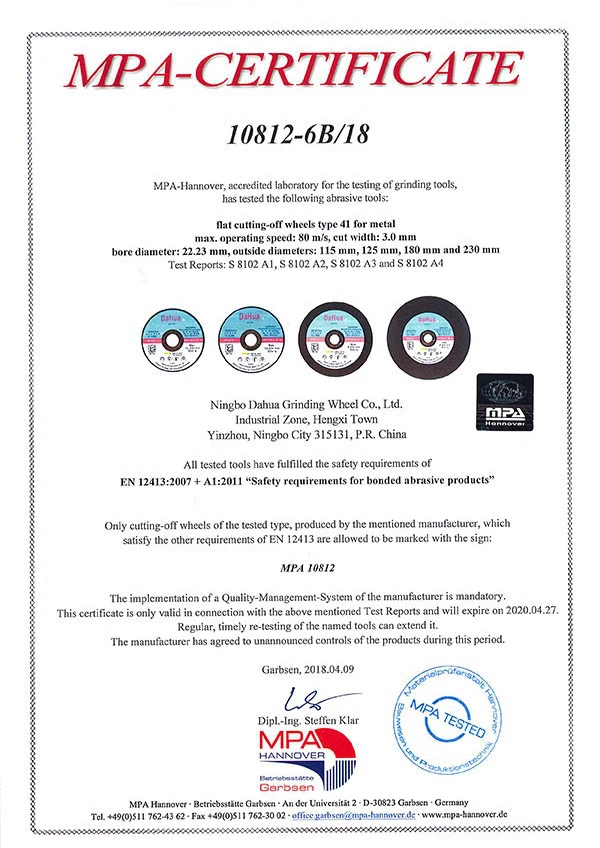
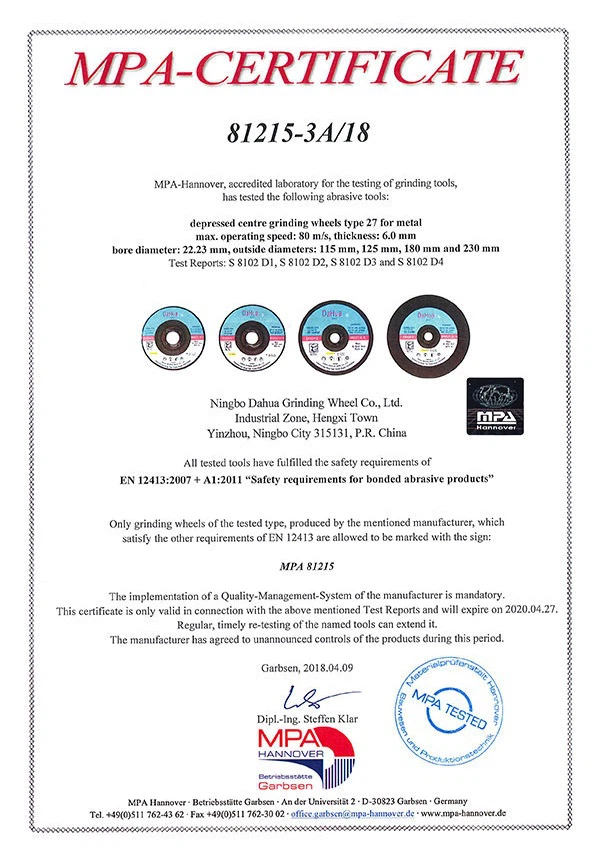
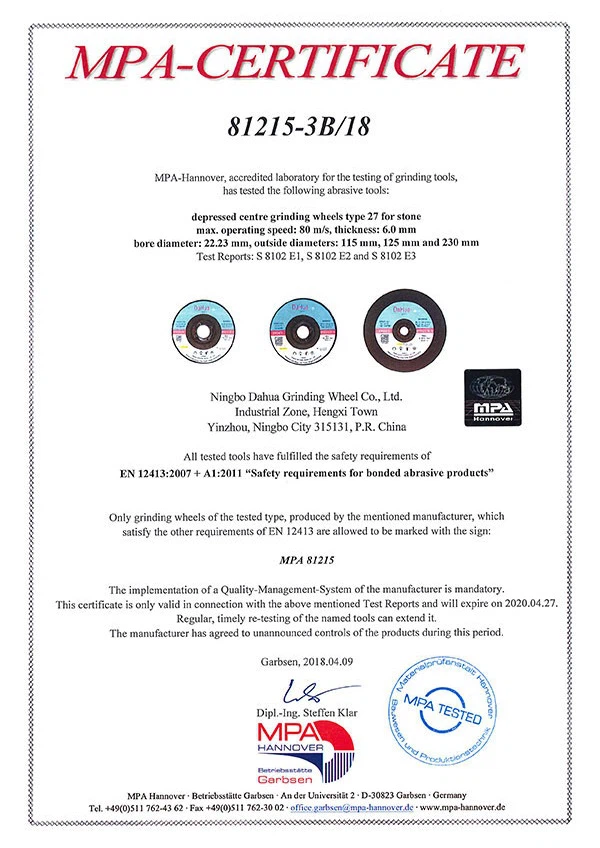
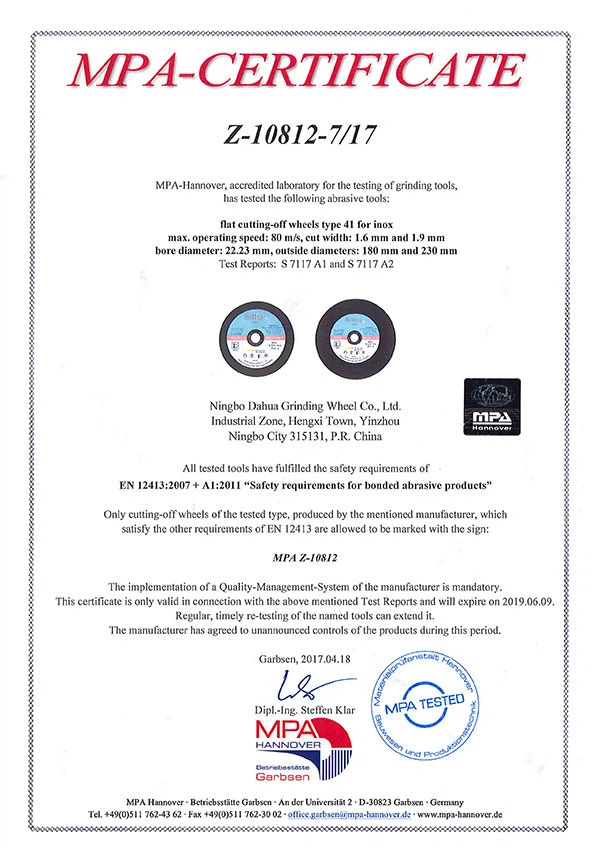
Our Certificate


FAQ
Q: What is an example of an abrasive?
A: Abrasives are used in the form of grinding wheels, sandpapers, honing stones, polishes, cutoff wheels, tumbling and vibratory mass-finishing media, sandblasting, pulpstones, ball mills, and still other tools and products.
Q: What is the most common abrasive wheel?
A: In general, the most commonly used types of abrasive wheels are: Type 1 Straight Grinding Wheels – straight wheels are a common type of revolution found on pedestal or bench grinders. It is often also widely used for centreless and cylindrical surface grinding operations.
Q: What are the three types of abrasive?
A: The four types of abrasives include:
Natural Abrasives.
Synthetic Abrasives.
Bonded Abrasives.
Coated Abrasives.
Natural Abrasives.
Synthetic Abrasives.
Bonded Abrasives.
Coated Abrasives.
Q: What three properties should an abrasive have?
A: Hardness: Hardness is paramount.
Toughness: An abrasive needs to withstand the pressure exerted during the grinding process.
Grain Structure: Determines the efficiency and finish of the abrasive action.
Toughness: An abrasive needs to withstand the pressure exerted during the grinding process.
Grain Structure: Determines the efficiency and finish of the abrasive action.
Q: Which is the hardest abrasive material?
A: Silicon carbide: Silicon carbide is the hardest abrasive blasting material available, making it the best choice for your most challenging surface finishing applications. It is available in various colors and purities.
Q: What is the most commonly used abrasive?
A: The most common abrasive used is aluminium oxide. Also common are silicon carbide, tungsten carbide and garnet. Artificial sharpening stones are often a bonded abrasive and are readily available as a two sided block, each side being a different grade of grit.
Q: What are the basics of abrasives?
A: An abrasive is a material used to finish (the act of polishing or making a surface smooth) or shape a workpiece through friction. The materials used on abrasives to create friction are often minerals. Abrasives are used for many different industrial, consumer, and technological applications.
Q: Are abrasives natural or chemical?
A: Natural abrasives include diamond, corundum, and emery; they occur in natural deposits and can be mined and processed for use with little alteration. Synthetic abrasives, on the other hand, are the product of considerable processing of raw materials or chemical precursors; they include silicon carbide.
Q: How are abrasives classified?
A: Abrasive materials are classified according to the hardness of their raw materials (measured on a scale, most commonly the Mohs Hardness Scale), as well as their brittleness (or friability) and toughness: Hardness refers to the resistance of one material to the pressure of another.
Q: What makes a good abrasive?
A: There needs to be a balance between flexibility and hardness as a harder bonding agent means the abrasive will be more aggressive and able to remove more material. If it's too hard however it will be brittle and crack more easily resulting in areas needing to be redone.
Q: What determines the grade of an abrasive?
A: The amount of abrasive bond in the grinding wheel determines its grade or hardness. Hardness is dependent on the grit type, the material being ground, the amount of stock removed, and a number of other factors. Hardness is rated from A-Z, with "A" being the weakest bond and "Z" being the strongest.
Q: Which material is very abrasive?
A: Silicon carbide is a sharp and hard abrasive material. It is one of the two most commonly used abrasive materials. The other is aluminum oxide.
Q: What mineral is the most abrasive?
A: Alumina, followed by silica sand and iron ore, is the most aggressive mineral in increasing wear rate. The least abrasive mineral is limestone, with red mud as a close second. Quantitatively, silica sand wears all materials 100 times faster than limestone.
Q: What is the most common material used for abrasives?
A: Many of them are minerals like quartz or diamond, which are two of the most widely used abrasives. Quartz is common abrasive material and is also known as silica sand. It is on the level 7/10 on the Mohs scale. On the other hand, diamond is composed of carbon atoms.
Q: What is the longest lasting abrasive?
A: Ceramic alumina – ceramic abrasives provide the longest life & fastest cut rate of all coated abrasives. They are the newest grain innovation and represent the ultimate in performance, providing an aggressive, consistent cut under moderate to high pressure.
Q: Which abrasive is the most widely used on metals?
A: From metalworking and fabrication to woodworking and auto body work, aluminum oxide has become the most used abrasive grain thanks to its unique blend of properties.
Q: What are the properties of abrasive materials?
A: An abrasive grain is a hard, tough substance containing many sharp projection cutting edges or points. It is used as a cutting tool to penetrate and cut away material that is softer than itself. Abrasive Materials used for abrasives are generally characterized by high hardness and moderate to high fracture toughness.
Q: What is the difference between grit and abrasive?
A: Abrasive blasting goes by many names, such as sandblasting, media blasting or grit blasting. These names all refer to the same method of surface cleaning and preparation. The only difference is the type of 'abrasive' used to do the work.
Q: What are the chemicals in abrasives?
A: Abrasives can be chemicals, materials, or minerals like feldspar, calcite, silica, and more. They can also be substances like salt, baking soda, and powdered borax. Read labels carefully as the level of abrasiveness of these items can vary, often dependent on colour coding.
Q: What is the hardest abrasive?
A: Silicon carbide is the ideal option for your most challenging surface finishing applications because it is the hardest abrasive blasting material currently on the market. It comes in a range of purities and colors.
We're professional abrasive suppliers in China, specialized in providing high quality products and service. We warmly welcome you to buy high-grade abrasive made in China here from our factory. For quotation and free sample, contact us now.
Portable Abrasives for Metal, Micro Black Abrasive, Black Abrasive for Metal