
What Is Flap Disc
Flap discs, also known colloquially as flapper wheels, have a design suited for right-angle grinder applications. They provide aggressive stock removal or precise blending and finishing depending on the operator's needs.
Why Choose Us
Rich Experience
Ningbo Dahua Grinding Wheel Co., Ltd. is a well-known Chinese company specializing in researching and producing resin abrasive products. It was founded in 1996 and mainly produces fiber-reinforced resin cutting and grinding wheels, rail cutting and grinding wheels, ordinary resin grinding wheels, fiberglass, etc.
Accept ODM/OEM Service
Based on many years of accumulated industry insight, production experience, innovation capability, and a service network in the abrasive industry, the company can not only offer high-quality customized products but also collaborate with other factories to research, design, and select new materials for new products.
Quality Control
The company has passed the ISO9001 Quality Management System certification and has a comprehensive quality assurance system. The equipment is advanced and reliable. It also has complete raw material inspection, finished product inspection centers, and a quality assurance team to ensure product stability.
-

Large Flap Disc
Large flap discs are used in grinding and finishing operations. They consist of a series of coated abrasive flaps attached to a rigid backing plate. This design allows the disc to wear away evenly as Add to Inquiry -
Silicon Carbide Flap Disc
Outside Diameter: 100 Add to Inquiry -
Flap Disc Paint Removal
Outside Diameter: 100 Add to Inquiry -
2 Inch Useful Flap Disc
Outside Diameter: 100 Add to Inquiry -
3 Inch Green Flap Disc
Outside Diameter: 100 Add to Inquiry -
6 Inch Thick Flap Disc
Outside Diameter: 150 Add to Inquiry -
180mm Black Flap Disc
Outside Diameter: 180 Add to Inquiry -
Zirconia Flap Disc Use
Outside Diameter: 100 Add to Inquiry -
Radial Flap Disc
Outside Diameter: 100 Add to Inquiry -
Large Flap Disc 7 Inch
Outside Diameter: 100 Add to Inquiry -
Industrial Vertical Flap Disc
Outside Diameter: 100 Add to Inquiry -
Large Flap Disc 230mm
Outside Diameter: 180 Add to Inquiry


Advantages of Using Flap Discs
01/
Versatility: Flap discs can be used for a wide variety of tasks, from grinding and deburring to finishing and polishing. They come in a variety of sizes, grits, and abrasive grains, which allows users to choose the right disc for their specific applications.
02/
Cooler cutting and reduced heat generation: The design of flap discs generates much less heat when compared to grinding discs. This is important when you don''t want to risk discoloring or warping a workpiece or destroying a soft metal like aluminum or brass.
03/
Longer life and less frequent replacement: The overlapping flaps on a flap disc continuously expose fresh abrasive material as they wear down, providing a longer lifespan and reducing the need for frequent disc changes.
04/
Better surface finishing: Compared to grinding wheels, flap discs are known to produce a smoother and more uniform finish. This helps eliminate the need for additional finishing steps and speeds up workflow.
What Grit Flap Disc Is Best for Surface Rust
When examining the panel or component. Rust is only on the surface, as you can see. Furthermore, you wish to get rid of the rust spots on your metal. Because you are aware that underneath is solid metal. Or you're not entirely certain. And you should look underneath that paint to discover what's there. You don't want to take off too much in this circumstance. Especially if the metal gauge is thin, to begin with.
Start your angle grinder slowly after mounting your flap disc with 120 grit. Removing the paint and rust from the surface.
The ideal starting point for grinding metal corrosion is 120 grits.
Then, if necessary, you can advance to an 80-grit flap disc and get more forceful.
And the rust isn't dissolving.

Best Flap Discs for Wood
The primary reason for using flap discs on wood is for high aggression shaping or for removing band saw marks. Of course it depends on whether you are sanding hardwoods or softwoods. Softwoods will wear down easily but can cause a disc to clog up. Hardwoods with a high silicate content can be more difficult to sand than steel.
● Best flap discs for soft woods
The biggest issue with using a flap disc on pine and other softwoods is the risk of the disc clogging up. If too much heat is generated then resinous woods can cause the surface of the flap disc to load. To prevent clogging use is a premium abrasive grain combined with a cotton backed material. The zirconia grain will sand quickly. The open cotton backing allows the cloth to breakdown consistently allowing you to use the full disc life.
● Best flap discs for hard woods
Sanding hardwoods can sometimes be more difficult than sanding metal. We therefore recommend a good quality abrasive grain with a stronger backing polyester backing. The discs have the premium grit and heavy duty backing you will need. If you need to use flap discs regularly on hardwoods. The most aggressive 115mm ceramic flap disc is the 40 grit.
Choosing Flap Disc Shape
Unlike a standard grinding wheel, which consists of a uniform grinding surface made of abrasive grains bonded in place, a flap disc consists of a ring of overlapping flaps. These flaps hold coated abrasive grains — the same grains used in bonded-abrasive cutting and grinding wheels — that can grind and shape a workpiece during fabrication or blend and finish a weld.
Where cutting and grinding discs often have a fiberglass structure, in flap discs the grains adhere to a backing cloth often made of cotton, polyester or a blend. The abrasive cloth is cut into smaller strips and then layer the strips so they overlap one another to form the flap disc. A rigid back plating provides stability and support.
The two most common types of flap discs are flat discs and conical discs:
● Flat discs:
Flat flap discs, also known as type 27 flap discs, typically grind best at shallower angles between 0 and 15 degrees. They are optimal for smooth finishing and blending on flat surfaces, and they can handle slight contours.
● Conical discs:
Conical flap discs, also known as type 29 flap discs, have a saucer-shaped grinding surface rather than a straight one. They typically grind best at angles between 15 and 35 degrees. They enable aggressive stock removal by maximizing surface contact on flat surfaces.
In general, operators should choose conical flap discs for initial high-volume grinding and flat flap discs for precision refinements.
A few specialty shapes and styles are also available:
Flap discs also come in a range of sizes, generally from about 4 to 7 inches in diameter, with the mini discs smaller still. Smaller discs are designed for use on die grinders to provide smooth grinding and enhanced conformability in tight areas. will rotate more quickly and provide a faster cut rate, whereas larger discs will rotate more slowly. Larger-diameter wheels contain more abrasive, however, so with the right care, because of their size will cover larger areas and will last longer and provide a higher rate of stock removal over the life of the disc.
● Trimmable discs:
Trimmable flap discs differ from other types because they contain a trimmable composite backing that allows the operator to increase flap overhang. When used as intended, these discs offer flexibility and versatility needed for hard-to-reach areas such as fillet welds and irregular shapes. The backings also prevent unwanted marking of the workpiece.
● Aluminum-backed discs:
Flap discs with aluminum backs contain a sturdy, permanent aluminum backing. This backing provides rigorous support in high-stress, heavy-duty applications such as pipeline fabrication.
● Mini discs:
Mini flap discs are significantly smaller than their standard counterparts, only about 2 or 3 inches in diameter. Their compact size makes them ideal for working in tight spaces and grinding hard-to-reach areas on the workpiece. A smaller, 2-inch mini disc can often effectively replace a blending disc as well. These discs contain a composite backing that provides standard support for a range of applications.
● Angled discs:
Angled flap discs have curved flaps that wrap around the edge of the backing plate, facilitating extensive flap-to-metal contact, enhancing operator control and allowing for a wider range of grinding angles. The curved flaps give these discs the contouring capabilities necessary for fillet welds and allow for access hard-to-reach areas for T-joint grinding. They offer the same robust grinding performance on flat surfaces.
Find the Appropriate Flap Disc Material
Abrasive flap discs come in various backing plate materials, each with pros and cons depending on your application.
The most popular backing plate materials include:
● Plastic: Backing materials are available in a range of plastics, although nylon is the most common. You can trim these backings to extend flap use, particularly during mixing and finishing. Plastics are cost-effective and compliant, which explains their growing popularity.
● Fiberglass: Fiberglass is one of the most sought-after backing material choices. It''s robust, lightweight and safe, forming a solid bond with the adhesive and eliminating the chance of contaminating the work surface. It also absorbs vibrations — excellent for operator comfort. As fiberglass also consists of layers, the more you add, the stronger the backing.
● Phenolic: Manufacturers create phenolic products by combining resin layers with composite fabric. This backing is lightweight and durable, fantastic to avoid damaging the workpiece.
● Metal: Metal backings are ideal for applications requiring extra support, strength and safety. However, they are more expensive, so using them only when necessary is perfect to maintain profitability.
● Composite: This backing choice is ideal to prevent marking the workpiece. It''s a trimmable backing, so you can adjust the disc''s dimensions, allowing access to hard-to-reach areas.
Once you''ve selected your backing, it''s time to consider the most effective abrasive grit material for your project. Some standard options include:
● Aluminum oxide: If you want to balance value and performance, aluminum oxide is a food choice. It''s durable, with a strong initial cut rate for fast stock removal. It''s ideal for all-purpose use but will dull over time.
● Ceramic alumina: Ceramic flap discs offer superior performance. As they grind, the grains microfracture to expose fresh, sharp edges consistently.
● Zirconia alumina: This self-sharpening option is perfect for aggressive stock removal and high-performance edge grinding. It provides a rapid cut and has excellent longevity when maintained correctly.
● Ceramic alumina and zirconia alumina blend: Combining the above options offers quick, accurate performance and enhanced disc longevity. Workers can achieve the same results with less effort.
What Are Flap Discs Used For
Flap discs shape metal and remove deposited welds and slag from the surface. They remove metal more slowly than grinding wheels and produce less spark. Flap discs are less durable than grinding wheels and can wear out quickly if not stored properly. They are safer and easier to use than other abrasive tools. While grinding and finishing, the flap disc generates less vibration and heat.

Our Factory
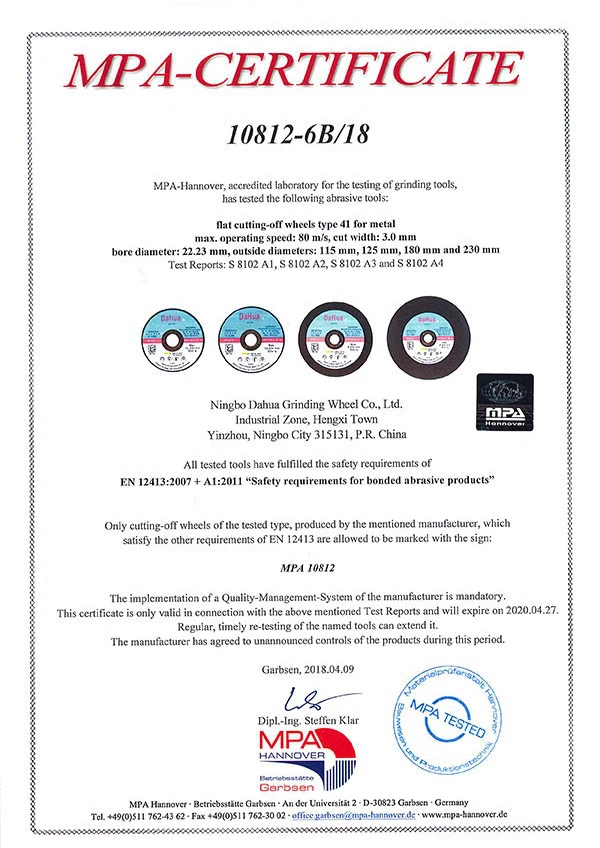
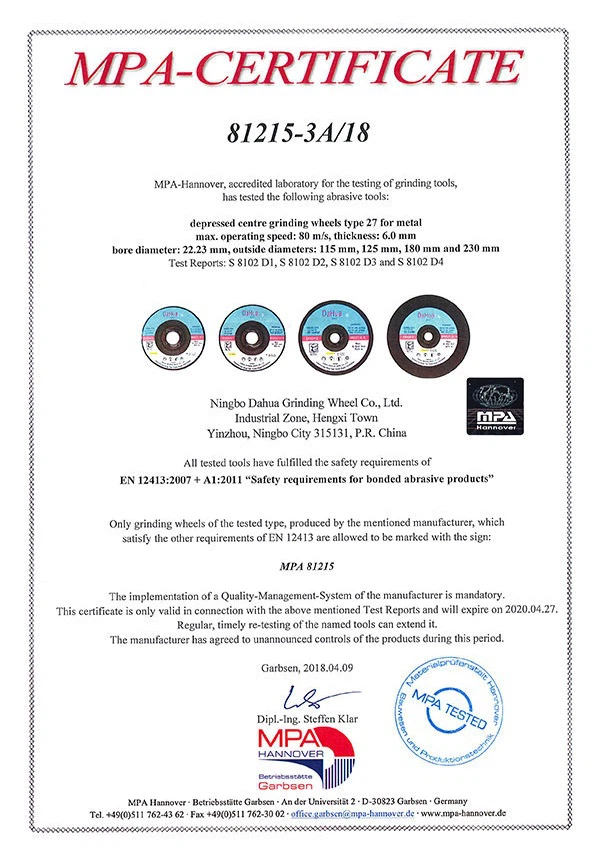
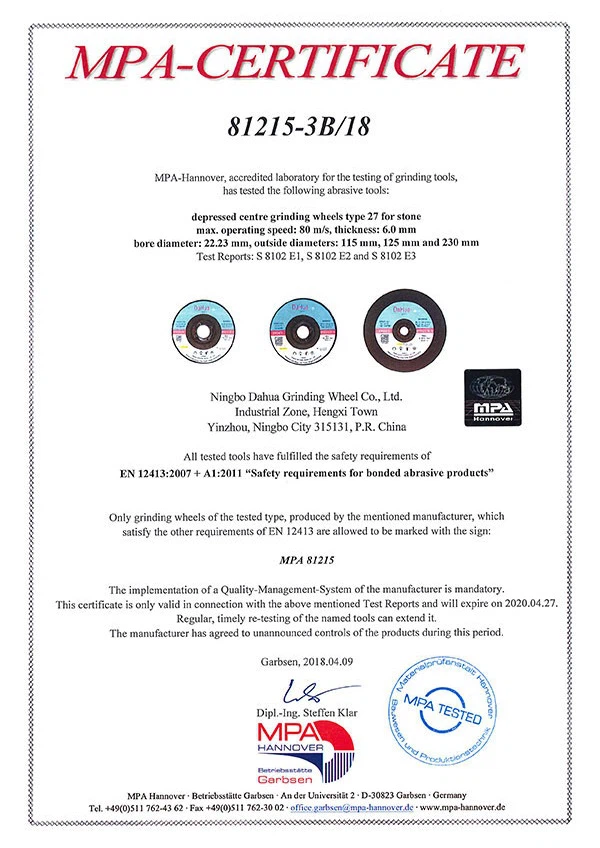
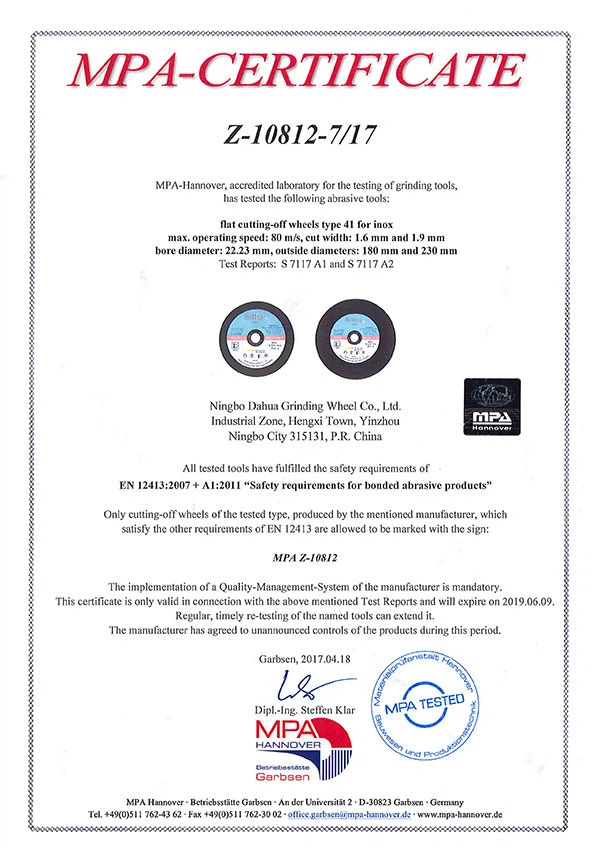
Ningbo Dahua Grinding Wheel Co.,Ltd. Is a well known Chinese company specialized in Researching and producing resin abrasive products. It was found in 1996, mainly produce fiber reinforced resin cutting and grinding wheel, rail cutting and grinding wheel, ordinary resin grinding wheel, fiber glass etc. The factory has Industrial Production License and Independent Exporting License. In the past 20 years, it sales to more than 70 countries in the world and the quality of products is universally recognized.
The company passed ISO9001 Quality Management System and has perfect quality assurance system. The equipment are all advanced and reliable. Also, it has perfect raw material inspect, finished product inspection center and quality assurance team to assure the stability of products.
The company awarded National high-tech enterprises in 2012 and awarded Provincial Engineering Technology Center in 2017. It has more than ten Independent intellectual property invention patent and professional R&D team to provide technical support to offer suitable product to the customers. Based on many years accumulation of industrial insight, produce experience, innovate ability and service network in abrasive industry, the company can not only offer high quality customized products, but also study, design and choose new material for new products together with other factory.
The company will go on struggle as always, renew and improve the quality of products constantly, maintain good services and competitive prices. Warmly welcome you to negotiate cooperation and create better business value.

Our Certificate


FAQ
Q: What is the difference between a sanding disc and a flap disc?
A: The main difference between flap discs and sanding discs is their ideal application. Flap discs are known for their versatility because they offer a blend of grinding and finishing capabilities in one tool. Sanding discs, on the other hand, can have a more aggressive cut, making them a go-to for rapid material removal.
Q: How long should a flap disc last?
A: When used properly, a flap disc can essentially be used until the cloth is almost completely worn down to the back plate. In general, flap discs are designed for use on right-angle grinders at angles from 5 to 35 degrees.
Q: Are flap discs good for removing rust?
A: A flap disc with 60 grit is an option. Remove the rusted edges. And see the rust flakes as they hit the ground. Clean up and use your 60-grit grinding wheel to remove as much of the rust as you can.
Q: How to get more life out of a flap disc?
A: Choosing the right speed can increase the life of your flap disc by up to 100%. In other words, if you are using the wrong speed, you could be halving the working life of your flap disc!
Q: What grit flap disc is best for surface rust?
A: When examining the panel or component. Rust is only on the surface, as you can see. Furthermore, you wish to get rid of the rust spots on your metal. Because you are aware that underneath is solid metal. Or you're not entirely certain. And you should look underneath that paint to discover what's there. You don't want to take off too much in this circumstance. Especially if the metal gauge is thin, to begin with.
Start your angle grinder slowly after mounting your flap disc with 120 grit. Removing the paint and rust from the surface.
The ideal starting point for grinding metal corrosion is 120 grits.
Then, if necessary, you can advance to an 80-grit flap disc and get more forceful.
And the rust isn't dissolving.
Start your angle grinder slowly after mounting your flap disc with 120 grit. Removing the paint and rust from the surface.
The ideal starting point for grinding metal corrosion is 120 grits.
Then, if necessary, you can advance to an 80-grit flap disc and get more forceful.
And the rust isn't dissolving.
Q: How to use a grit flap disc on pitted rust?
A: You can feel that the rust is deeper than the surface when you rub it. Your metal has some areas where rust is more deeply ingrained. And you are aware of the peaks and valleys. It makes no difference if it is a metal fence or railing. You're working on a door or other metal furnishings.
Choose a flap disc with a 60-grit rating. But be cautious. Especially if you are working with light gauge metal.
Use a delicate touch. Because using a flap disc too roughly runs the danger of damaging your metal.
Start by coaxing the rust off using an 80-grit flap disc if you tend to be a touch heavy-handed.
You should probably also bring a wire wheel to the pits. Get as much rust off the railing or tractor part as you can.
Choose a flap disc with a 60-grit rating. But be cautious. Especially if you are working with light gauge metal.
Use a delicate touch. Because using a flap disc too roughly runs the danger of damaging your metal.
Start by coaxing the rust off using an 80-grit flap disc if you tend to be a touch heavy-handed.
You should probably also bring a wire wheel to the pits. Get as much rust off the railing or tractor part as you can.
Q: Why use a flap disc?
A: Flap discs are used for grinding, blending, and finishing, as well as removing rust, paint, and weld seams. One of the primary advantages of flap discs is that they provide a consistent finish without gouging the surface. This makes them ideal for contouring and smoothing surfaces.
Q: Can I use a flap disc to sand wood?
A: Sanding hardwoods can sometimes be more difficult than sanding metal. We therefore recommend a good quality abrasive grain with a stronger backing polyester backing.
Q: Can you sand with a flap disc?
A: The bevel on the flap disc has a 15 degree angle. If the angle grinder is held at 15 degree angle to the workpiece then the abrasive face will grind flat to the metal. Consequently, conical faced flap discs are by far the most common for metal grinding and sanding.
Q: Can you cut with a flap disc?
A: Flap discs are the recommended choice when you're working with metal, especially when you intend to make right angle cuts. Being flexible, these discs make it easier to achieve contours in the metal. For grinding, apply heavy pressure and for finishing, apply light pressure.
Q: What is a 120 grit flap disc used for?
A: 50 To 60 grit flap discs are medium, so they are recommended for deburring and deflashing applications. 60 to 80 grit range is fine and typically used for rust removal and blending. 80 to 120 grit flap discs are finer and well-suited for refining applications such as cleaning and finishing.
Q: Will a flap disc grind concrete?
A: Excellent versatility: Flap discs allow you to grind, bend and finish with a single tool. They are ideal for applications from woodworking to concrete grinding or finishing. Improved maneuverability: A flap disc is a lightweight and easy-to-use solution, allowing grinders to complete tasks faster and more accurately.
Q: When to replace a flap disc?
A: To ensure safe operation, replace the flap wheel if there are any visible signs of damage or excessive wear. By monitoring these factors and replacing flap wheels when necessary, you can ensure optimal performance and safety during surface preparation and finishing tasks.
Q: How to properly use a flap disc?
A: All of these can lead to separation of the flaps or backing disc breakage. Type 27 flap discs should be used at 0°-15° angle and Type 29 flap discs should be used at 15°-25° angle to the workpiece. Do not use flat or on the edge.
Q: Can you cut with a flap disc?
A: Flap discs are the recommended choice when you're working with metal, especially when you intend to make right angle cuts. Being flexible, these discs make it easier to achieve contours in the metal. For grinding, apply heavy pressure and for finishing, apply light pressure.
Q: Do flap discs expire?
A: All good quality discs will have an expiry date stamped on them somewhere. This is usually found on the central metal ring or on the disc itself. Occasionally it will be on a label attached to the disc. It is important to note that this is a "use by" date that should never be exceeded.
Q: What is the difference between a grinding disc and a flap disc?
A: Better surface finishing – Compared to grinding wheels, flap discs are known to produce a smoother and more uniform finish. This helps eliminate the need for additional finishing steps and speeds up workflow.
Q: Are flap discs good for paint removal?
A: Flap discs are designed for angle grinders and can do a great job removing paint faster than most other tools. However, most angle grinder flap discs are designed to work for heavy stock removal. You should try not to force too much pressure when using a flap disc to remove paint.
Q: Is a flap disc used for sanding?
A: Grinding wheels are most commonly used for various grinding, abrasive cutting, and machining jobs, while flap discs are used to conform and shape metal, and sanding discs are used for sanding metal, wood, and other materials.
Q: What is the difference between T27 and T29 flap discs?
A: On flat surfaces, T27 flap discs work best for heavy-duty grinding and stock removal, but T29 flap discs work best for finishing and blending on curved surfaces. Consider the material you're working with, the kind of finish you desire, and the surface shape when selecting a flap disc.
We're professional flap disc suppliers in China, specialized in providing high quality products and service. We warmly welcome you to buy high-grade flap disc made in China here from our factory. For quotation and free sample, contact us now.
Solid Flap Disc, Flap Disc Paint Removal, 180mm Black Flap Disc