
What Is Grinding Wheel
Grinding wheels are wheels that contain abrasive compounds for grinding and abrasive machining operations. Such wheels are also used in grinding machines.
The wheels are generally made with composite material. This consists of coarse-particle aggregate pressed and bonded together by a cementing matrix (called the bond in grinding wheel terminology) to form a solid, circular shape. Various profiles and cross sections are available depending on the intended usage for the wheel. They may also be made from a solid steel or aluminium disc with particles bonded to the surface.
Why Choose Us
Rich Experience
Ningbo Dahua Grinding Wheel Co., Ltd. is a well-known Chinese company specializing in researching and producing resin abrasive products. It was founded in 1996 and mainly produces fiber-reinforced resin cutting and grinding wheels, rail cutting and grinding wheels, ordinary resin grinding wheels, fiberglass, etc.
Accept ODM/OEM Service
Based on many years of accumulated industry insight, production experience, innovation capability, and a service network in the abrasive industry, the company can not only offer high-quality customized products but also collaborate with other factories to research, design, and select new materials for new products.
Quality Control
The company has passed the ISO9001 Quality Management System certification and has a comprehensive quality assurance system. The equipment is advanced and reliable. It also has complete raw material inspection, finished product inspection centers, and a quality assurance team to ensure product stability.
-

120 Grit Grinding Wheel
Grinding wheels are discs that contain abrasive particles and grains that have been bonded together to form a wheel shape. Although the disc format is the most common shape, they can also be made in Add to Inquiry -
120 Grit Grinding Wheel
Outside Diameter: 100 Add to Inquiry -
60 Grit Grinding Wheel
Outside Diameter: 100 Add to Inquiry -
Rust Grinding Wheel
Outside Diameter: 115 Add to Inquiry -
Grinding Wheel for Sharpening Carbide Tools
Outside Diameter: 115 Add to Inquiry -
Round Edge Grinding Wheel
Outside Diameter: 115 Add to Inquiry -
Stone Grinding Wheel for Flour
Outside Diameter: 115 Add to Inquiry -
Grinding Wheel for Milling Machine
Outside Diameter: 115 Add to Inquiry -
Carbide Wheel Grinding
Outside Diameter: 115 Add to Inquiry -
Ruby Grinding Wheel
Outside Diameter: 115 Add to Inquiry -
Grinding Wheel Cleaning Tool
Outside Diameter: 115 Add to Inquiry -
4.5 Inch Diamond Grinding Cup Wheel
Outside Diameter: 115 Add to Inquiry


What Are Grinding Wheels Used For
Straight grinding wheels are usually used in bench grinders.
Cylinder grinding wheels are used in horizontal or vertical spindle grinders to make flat surfaces.
Tapered grinding wheels are wider in the centre with a surface that tapers outwards. These wheels are used to grind gear teeth or threads.
Straight cup grinding wheels are fitted to cutter machines and used to sharpen tools or to make flat surfaces.
Dish grinding wheels are thin with a flat centre that is raised outwards on the edge. These wheels are commonly used to cut openings such as slots.
Saucer grinding wheels have a straight edge section and are used for twist mills and grinding cutters.

Types of Grinding Wheels
Various grinding discs are designed for different purposes, depending on the material and task.
Some of the most common types include:
● Straight grinding wheels: Used for cylindrical, centerless, and surface grinding.
● Grinding/cutting wheels: Thinner discs that can be used for either grinding or for cutting materials into parts.
● Depressed center grinding wheels: These are used for smoothing and finishing surfaces, mainly metal.
Shelf Life of Grinding Wheels
It has always been recommendation that resinoid bonded grinding wheels be used up within 2 years from the date of manufacture. This recommendation assumes that resinoid bonded grinding wheels have been stored under ideal storage conditions. It may be true under ideal storage conditions resinoid bonded grinding wheels can survive without any degradation in strength for well over two years. It is always wise to suspect any wheels over two years old and have them reinspected or re-speed tested to determine if there has been any degradation in strength. If the wheels are stored under less than ideal conditions, they may have a much shorter shelf life depending upon the severity of storage conditions.
These same comments also apply to rubber and shellac bonded grinding wheels. As for vitrified grinding wheels, the shelf life is less influence by humidity and adverse storage conditions as compared to resinoid, rubber or shellac, but even vitrified grinding wheels do not have an infinite shelf life.
The best procedure and the best rule of thumb is to have any wheel that is two years old or older re-speed tested and reinspected to ensure it is fit for use.
Keep in mind that this procedure is good to verify the reliability of a product but must not be performed until you are ready to consume the wheel. If wheels are sent back after the two year time frame for reinspection and retesting and then put back on the shelf, there is no telling how long they will be fit for use after that last inspection.
Grains and Grain Blends: Grinding Wheel
The abrasive grains provide the essential functionality of a grinding wheel because they remove material from the workpiece. A few commonly used grinding wheel abrasives are ceramic alumina, zirconia alumina, aluminum oxide, white aluminum oxide, aluminum oxide and silicon carbide. Grains can be blended together to achieve different performance characteristics as well.
● Ceramic alumina: These grains offer the benefit of self-sharpening and micro-fracturing crystals. They are relatively cool when in use, and they provide the longest operating life under moderate to high pressure. They grind at lower temperatures and generate less friction — one main benefit of these qualities is that they minimize heat discoloration on the workpiece. Ceramic alumina is ideal for hard-to-grind metals such as armored steel, titanium, hard nickel alloys, tool steel and stainless steel.
● Zirconia alumina: Zirconia alumina grains provide a fast cut and a long life on metal workpieces. They are self-sharpening and deliver rapid, consistent grinding, especially on metals like steel and stainless steel. They also hold up well under high pressures and extreme temperatures.
● Zirconia alumina blended with ceramic alumina: If you like the performance of a zirconia alumina grinding wheel but are looking for an extra boost a blend with ceramic alumina will deliver faster cutting with less effort.
● White aluminum oxide: White aluminum oxide grinding wheels offer a relatively fast cut-rate and an extensive lifespan. They are ideal for grinding stainless steel and harder-grade steel.
● Aluminum oxide: An aluminum oxide grain is ideal for steel, iron and other metals. Although it is hard and durable and provides a sharp, fast initial cut, the grain dulls over time and lacks the cut-rate and potential longevity of some other grains.
● Silicon carbide: Silicon carbide is an extremely hard grain that is very sharp and fast cutting but friable, not as tough as other grains.
● Silicon carbide/aluminum oxide blend: A wheel made from a blend of silicon carbide and aluminum oxide provides ideal grinding for aluminum and other soft alloys. These grains offer extended life spans and fast, consistent cut rates on aluminum and other soft metals.
What Does the Green Stripe on a Grinding Wheel Indicate
The maximum operating speed of abrasive tools is the maximum speed at which rotating abrasives can be operated when fitted to the corresponding grinders during application.
It is given in m/s and defined by the applicable standards in an effort to avoid and reduce risks. These standards also designate the different levels of possible maximum operating speeds according to which the abrasives need to be manufactured as well as the identification of these levels and the maximum permissible rotational speeds as a function of the diameter.
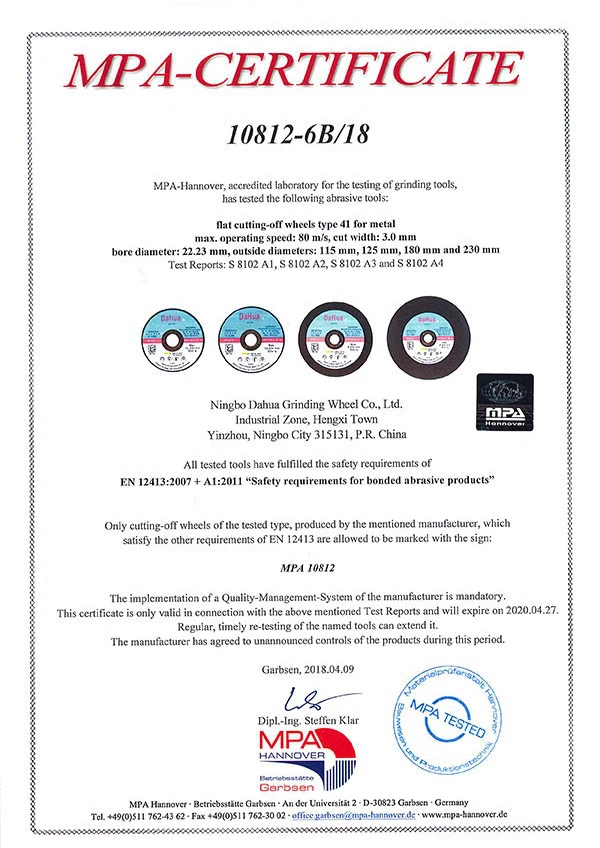
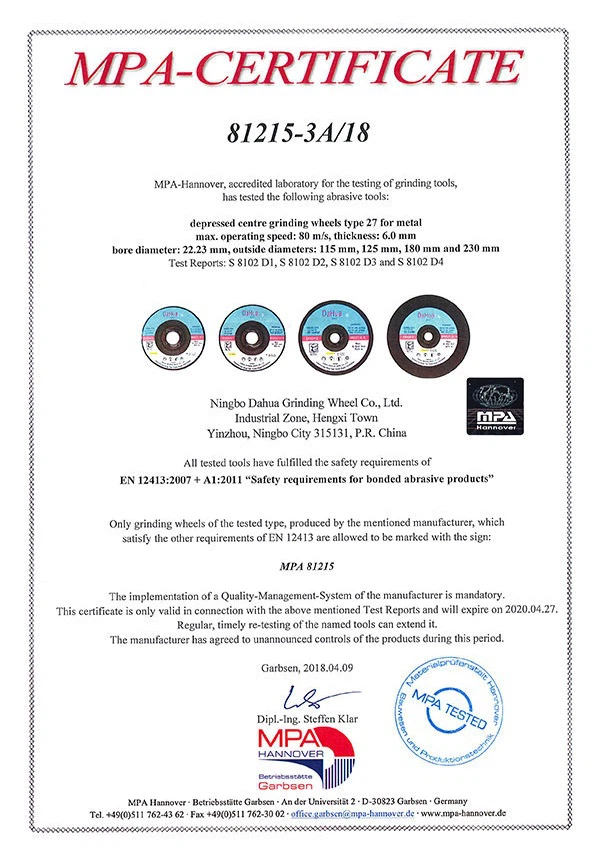
While no longer mandatory, the colour coding used to designate the maximum operating speed, which used to be required by regulations until recently, is still frequently used in the form of coloured stripes applied on the abrasive tools (e.g. 50 m/s = blue bar, 63 m/s = yellow bar, 80 m/s = red bar, 100 m/s = green bar).
For safety reasons, the user should strictly ensure not to exceed the maximum operating speed specified on the abrasive.

What Does Grit of a Grinding Wheel Indicate
Abrasive is the material from which the wheel is made. This is what does the work. Most common abrasives include, Aluminum Oxide, Silicon-Carbide, Zirconia Aluminum Oxide, Cubic Boron Nitride (CBN) and Synthetic Diamond.
Next is Grit. This is the size of the abrasive grain in the wheel. As you probably know, the lower the number, the coarser the grit. Coarse grits are used for soft, pliable, stringy materials when you want fast material removal, have a large contact area and high pressure. Finer grits are used to produce smooth finishes and when you're grinding hard, brittle materials and have a small contact area.
Coarse grits are 8, 10, 12, 14, 16, 20 and 24
Normal grits are 30, 36, 46, 54, 60 and 70
Fine grits are 80, 90, 100, 120, 150, 180 and 220
Very Fine grits are 240, 280 and up
Grade refers to the strength of the bond (we'll get to bond in a bit) that holds the abrasive grains together. This can range from very soft to very hard and is represented A to Z in grinding wheel specs.
Softer grade wheels cut faster with less chatter. They require lower amps or power to drive them, have shorter wheel life and produce a worse finish. Harder grades cut slower with more chatter. The produce a better finish and have a longer life, but require more power/amps to operate.
Structure denotes the spacing of the abrasive grains in the wheel. The lower the structure number, the denser the wheel. Structure numbers range from 0 to 14.
General Grinding Wheel Safety
These high speed abrasive discs can be extremely dangerous if used incorrectly. Below are some basic tips for grinder wheel safety that should always be observed, even if you're just doing quick touch-up work.
● Always wear proper PPE
● Always inspect your grinding wheels before use for any damages, such as defects, cracks, or chipping
● Always match the diameter of the grinding wheels with the appropriate angle grinder
● Never remove or modify the angle grinder guard
● Never use an angle grinder with a higher RPM rating than the wheel
● Always allow the grinder to warm up, coming up to full speed before each use
● Always allow the grinder to come to a complete stop after use
● Always use two hands on your angle grinder
● Do not wear baggy clothing while operating an angle grinder
Our Factory
Ningbo Dahua Grinding Wheel Co.,Ltd. Is a well known Chinese company specialized in Researching and producing resin abrasive products. It was found in 1996, mainly produce fiber reinforced resin cutting and grinding wheel, rail cutting and grinding wheel, ordinary resin grinding wheel, fiber glass etc. The factory has Industrial Production License and Independent Exporting License. In the past 20 years, it sales to more than 70 countries in the world and the quality of products is universally recognized.
The company passed ISO9001 Quality Management System and has perfect quality assurance system. The equipment are all advanced and reliable. Also, it has perfect raw material inspect, finished product inspection center and quality assurance team to assure the stability of products.
The company awarded National high-tech enterprises in 2012 and awarded Provincial Engineering Technology Center in 2017. It has more than ten Independent intellectual property invention patent and professional R&D team to provide technical support to offer suitable product to the customers. Based on many years accumulation of industrial insight, produce experience, innovate ability and service network in abrasive industry, the company can not only offer high quality customized products, but also study, design and choose new material for new products together with other factory.
The company will go on struggle as always, renew and improve the quality of products constantly, maintain good services and competitive prices. Warmly welcome you to negotiate cooperation and create better business value.

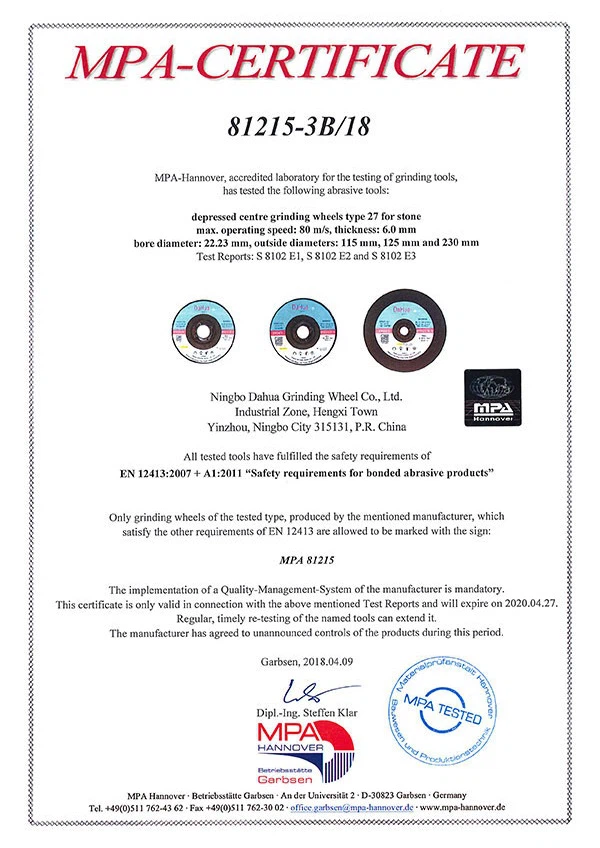
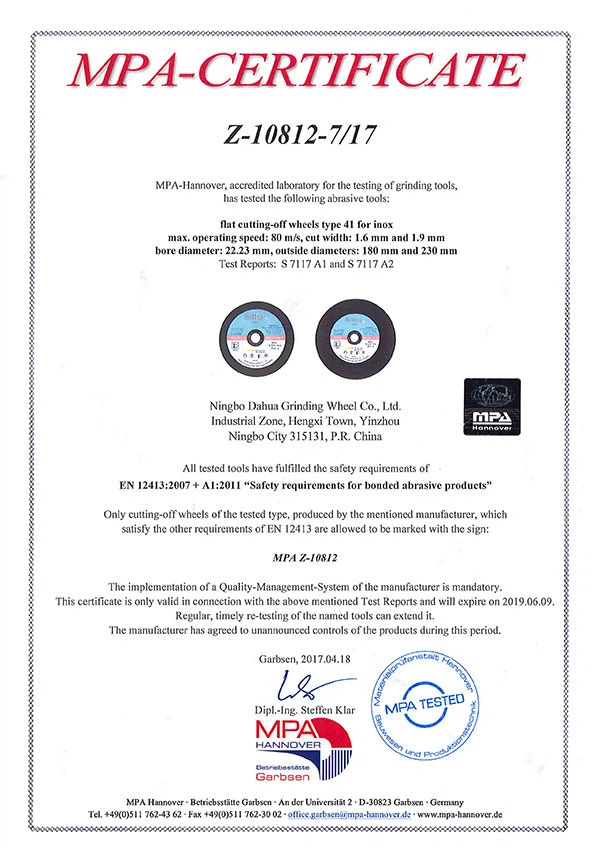
Our Certificate


FAQ
Q: What is grinding wheel?
A: Grinding wheels are wheels that contain abrasive compounds for grinding and abrasive machining operations. Such wheels are also used in grinding machines.
The wheels are generally made with composite material. This consists of coarse-particle aggregate pressed and bonded together by a cementing matrix (called the bond in grinding wheel terminology) to form a solid, circular shape. Various profiles and cross sections are available depending on the intended usage for the wheel. They may also be made from a solid steel or aluminium disc with particles bonded to the surface.
The wheels are generally made with composite material. This consists of coarse-particle aggregate pressed and bonded together by a cementing matrix (called the bond in grinding wheel terminology) to form a solid, circular shape. Various profiles and cross sections are available depending on the intended usage for the wheel. They may also be made from a solid steel or aluminium disc with particles bonded to the surface.
Q: What is a grinding wheel used for?
A: Grinding wheels are attached to grinders or saws and rotated at high speeds for a variety of tasks. The abrasive grit and grains in the wheel are able to grind or cut through hard materials such as metal or steel. The abrasive grains are bonded together by either organic or inorganic substances.
Q: What causes a grinding wheel to wear?
A: Excessive pressure: Applying too much force during grinding. Incorrect speed: Operating the wheel at speeds higher or lower than recommended. Poor quality materials: Using wheels made from substandard abrasive materials.
Q: What does grinding wheel grade mean?
A: The amount of abrasive bond in the grinding wheel determines its grade or hardness. Hardness is dependent on the grit type, the material being ground, the amount of stock removed, and a number of other factors. Hardness is rated from A-Z, with "A" being the weakest bond and "Z" being the strongest.
Q: What is a type 5 grinding wheel?
A: Type 5. It is used for surface grinding, i.e. production of flat surfaces. Grinding takes place with the help of face of the wheel.
Q: When should you throw away a grinding wheel?
A: For cutting and grinding discs, always monitor the expiry date (imprinted in the metal disc). They shouldn't be used after this due to the organic bond deteriorating. Stock control should ensure the older wheels are used first.
Q: Do grinding wheels contain asbestos?
A: Carborundum diamond grinding wheels contained asbestos,which was used as a filler in the wheel's non-abrasive center, or core. The grinding wheel core was made from a material known as Bakelite, which contained asbestos fillers. Grinding wheels have holes in the center so that they can be attached to grinding machines.
Q: What are the precautions of grinding wheel?
A: Wear goggles for all grinding machine operations. Check grinding wheels for cracks before mounting. Do not exceed recommended depth of cut for the grinding wheel or machine. Remove workpiece from grinding wheel before turning machine off.
Q: How long should a grinding wheel last?
A: It has always been recommendation that Resinoid Bonded grinding wheels be used up within 2 years from the date of manufacture. This recommendation assumes that Resinoid Bonded grinding wheels have been stored under ideal storage conditions.
Q: What is the most common grinding wheel?
A: Type 27 is by far the most common abrasive grinding wheel. Type 27 grinding wheels differ from other wheels in that they have a flat profile with a depressed center.
Q: Are grinding wheels safe?
A: The most common are injuries to the eyes from flying particles, hand and finger injuries and injuries caused by grinding wheel breakage. Injuries from grinding wheels can be prevented by the use of eye protection, safe work practices and proper care and guarding of the grinding wheel.
Q: What is the life of a grinding wheel?
A: Grinding wheels are consumables, although the life span can vary widely depending on the use case, from less than a day to many years. As the wheel cuts, it periodically releases individual grains of abrasive, typically because they grow dull and the increased drag pulls them out of the bond.
Q: What does the green stripe on a grinding wheel indicate?
A: While no longer mandatory, the colour coding used to designate the maximum operating speed, which used to be required by regulations until recently, is still frequently used in the form of coloured stripes applied on the abrasive tools (e.g. 50 m/s = blue bar; 63 m/s = yellow bar, 80 m/s = red bar; 100 m/s = green bar.
Q: What should be done before installing a grinding wheel?
A: Disconnect portable machines from their power source before you begin mounting or removing wheels. Inspect the machine and its wheel guard. Never use a machine that has been damaged or one that does not have a proper abrasive cup wheel guard. Inspect and clean the machine's back flange and mounting threads.
Q: What does grit of a grinding wheel indicate?
A: Next is grit. This is the size of the abrasive grain in the wheel. As you probably know, the lower the number, the coarser the grit. Coarse grits are used for soft, pliable, stringy materials when you want fast material removal, have a large contact area and high pressure.
Q: How tight should a grinding wheel be?
A: To prevent flange damage and grinding wheel breakage, you must use a torque wrench. Requires that applied torque should not exceed 20 foot pounds unless greater torque is recommended or approved by the machine builder. The maximum permissible applied torque is dependent on flange design and materials.
Q: Which PPE is required when using the grinding wheel?
A: The first step in using an angle grinder safely is to follow basic safety procedures. This includes wearing the appropriate personal protective equipment (PPE), such as hearing protection, safety glasses, a face shield, gloves and flame-resistant clothing.
Q: What happens to a grinding wheel as it wears?
A: A portion of each of the individual grains on the wheel surface breaks apart and leaves the remaining grain bonded to the wheel. The fractured grain is left with newly exposed sharp edges which attribute the self-sharpening characteristic of grinding wheels and cutting tools in general.
Q: When should you replace a grinding wheel?
A: If the edge of the disk feels smooth, the blade has worn down, and the disc needs replacing. However, if you intend to identify the disc's quality in this way, be aware that the edge is naturally sharp and can pose a risk of injury if it doesn't need replacing.
Q: How can you test a grinding wheel for cracks?
A: The ring test depends on the fact that a crack in the wheel will normally change the sound emitted when the wheel is lightly tapped. An undamaged wheel will give a clear tone. If cracked, there will be a dead sound and not a clear ring.
We're professional grinding wheel suppliers in China, specialized in providing high quality products and service. We warmly welcome you to buy high-grade grinding wheel made in China here from our factory. For quotation and free sample, contact us now.
Carbide Wheel Grinding, grinding wheel, Ruby Grinding Wheel