
What Is Cutting Wheel
Cutting wheels (aka cut-off discs) are an abrasive tool used for fast cutting of materials like metal, concrete, and stone. Their portability allows the operator to move around freely with it and maneuver their tools from different angles to easily cut a material.
Why Choose Us
Rich Experience
Ningbo Dahua Grinding Wheel Co., Ltd. is a well-known Chinese company specializing in researching and producing resin abrasive products. It was founded in 1996 and mainly produces fiber-reinforced resin cutting and grinding wheels, rail cutting and grinding wheels, ordinary resin grinding wheels, fiberglass, etc.
Accept ODM/OEM Service
Based on many years of accumulated industry insight, production experience, innovation capability, and a service network in the abrasive industry, the company can not only offer high-quality customized products but also collaborate with other factories to research, design, and select new materials for new products.
Quality Control
The company has passed the ISO9001 Quality Management System certification and has a comprehensive quality assurance system. The equipment is advanced and reliable. It also has complete raw material inspection, finished product inspection centers, and a quality assurance team to ensure product stability.
-

8 Inch Cutting Wheel
8 Inch cutting wheels, or cut-off wheels, are abrasive wheels designed for clean cuts through metals. Cutting wheels come in two main types; Type 1 and Type 27. Type 1 cut-off wheels are flat for the Add to Inquiry -
7 Inch Cutting Wheel
7 Inch cutoff wheels are perfect for metal slotting, cutting sheet metal, stud or bolt removal, as well as many other metal cutting applications. These discs can be used to cut stainless steel, Add to Inquiry -
Useful 9 Inch Cut Off Wheel
Outer diameter:230/230 Add to Inquiry -
7 Inch Cutting Wheel
Outer Diameter: 180/180 Add to Inquiry -
4 Inch Metal Cutting Wheel
Outer Diameter: 100 Add to Inquiry -
6 Inch Cutting Wheel
Outer Diameter: 150 Add to Inquiry -
Cutting Wheel for Tile Cutter
Outer Diameter: 115 Add to Inquiry -
3 Inch Cut Off Wheels for Metal
Outer Diameter: 150 Add to Inquiry -
Useful Cordless Cutting Wheel
Outer Diameter: 115 Add to Inquiry -
Large Cutting Wheel 12 Inch
Outer Diameter: 300 Add to Inquiry -
8 Inch Cut Off Wheel
Outer Diameter: 200 Add to Inquiry -
12 Inch Cut Off Wheel
Outer Diameter: 300 Add to Inquiry


What Are Cutting Wheels Made Of
High-quality cutting discs are made of resinoid-bonded abrasives. The bonding agent, resinoid, holds the wheel and the abrasive material together. As it wears away through use, fresh sharp grains are exposed to continue cutting to extend the long life of the product.
The most commonly used abrasives embedded in the resinoid wheels are aluminum oxide and silicon carbide.
Reinforced cutoff wheels are the most durable cut wheels. They are reinforced with fiberglass to provide extra strength to last long and avoid breaking from extra pressure forced on it.

Cutting Wheels Are for Cutting on the Periphery
Cutting wheels are thin by design and do not have adequate lateral strength for side grinding.
The fiberglass reinforcement is in the wheel to add strength. Using the side of the wheel can damage the fiberglass. This reduces the strength of the wheel and can lead to breakage.
Regardless of what type of grinding wheel you are using, grinding must only be performed on the surface of the wheel for which it is designed.
Using a cutting-off wheel for side grinding can have serious consequences. The photographs seen here show what can happen to a cut-off wheel when the side is used for deburring or grinding. The workpiece can cut through the reinforcing side fiberglass weakening the wheel. This may result in wheel breakage and injury.
Where to Start When Selecting a Cutting Wheel
Cutting wheels are efficient and made from bonded adhesives. Bonded adhesives include a mix of resin and quality abrasive material. This mix is hardened into a solid cutting wheel to provide a stable, lasting cutting surface. We offer cutting wheels compatible with die grinders, angle grinders, chop saws, stationary saws and high-speed gas saws. The best wheel option fits the tool and does not exceed its maximum RPM safety rating.
Wheel type is another consideration when selecting a cutting wheel. Type 1 wheels have a flat profile that allows for deep cuts. These wheels are also often referred to as cut-off wheels or slicing wheels. offers Type 1 cutting wheels for die grinders, angle grinders, chop saws, stationary saws and high-speed gas saws.
The second type is a Type 27 cutting wheel, which has a depressed center or raised hub that provides added clearance when working at a constrained angle. These depressed-center cutting wheels are available in a range of sizes for right angle grinders.
Metals vary in hardness and composition. In addition to tool compatibility and wheel type, the cutting wheel needs to fit the application and the metal material being cut. Wheel thickness is something else to consider — when cutting metal, less is sometimes more. In selecting a wheel, always choose the thinnest wheels that will perform the cut while maintaining the desired product life. Thinner wheels will remove less material and create fewer burrs during the cut.
Cutting Wheel Safety Always Dos


● Always wear proper safety equipment. Personal protective equipment is extremely important. This includes wearing safety glasses, along with goggles, and/or a face shield. We also recommend wearing other protective equipment, as needed, dust masks and gloves.
● Always do a safety check of each cut-off wheel before usage. Check for cracks or any damage. This will prevent flying bits around the shop or a broken disc from shattering during use.
● Prior to use, check the maximum operating speed marked on the wheel and compare it against the machine's speed.
● Check to make sure that your disc is the right size for your angle grinder or other power tool you plan on using it with. Using one too small or too large can be dangerous.
● Do ensure the cut-off wheel is meant for the material you are using it on. This also prevents contamination and waste of materials and wheels. This step can save you quite a bit of overhead cost.
● Do make sure your portable cut-off wheels are mounted on grinders that have proper guards and proper flanges.
● Do position the wheel guard so that it is properly in place between the operator and the cut-off wheel.
● Always do a one-minute test run of your wheel in a protected area before cutting. This allows for you to ensure the wheel will be safe to use before cutting your workpiece.
● Always do a check to ensure that the workpiece is secure at both ends before cutting. The slightest movement or sliding of the piece can be a major hazard.
● Do ensure that the portable cut-off wheel is only used for cutting metal. Never use it for a task it isn't intended for like grinding or deburring.
● Always maintain a 90-degree angle for the cut-off wheel to the workpiece.
● Always stop cutting when you hear or feel any unusual vibrations, sounds, or if something doesn't feel right. Inspect the wheel before continuing on.
● Always do your best to prevent impacts to the cut-off wheel. If an impact happens stop cutting and inspect the wheel for damage -- change your wheel if damage is seen.
● Do use a moderate and consistent rate of feeding to the wheel.
● Do keep all clothing and body parts clear of the cut-off wheel, especially while it is in motion. This also includes your protective wear.
● Always be aware of your surroundings and the spark stream to protect both yourself and bystanders.
● Do ensure your work area is clear of flammable materials.
● Always replace wheel guards that show any sign of damage.
● Always handle and store your portable cut-off wheels carefully and safely.
● Do check your wheel for all warnings and follow all of them.
● Always review safety data sheets for your wheel and the material your wheel shall be cutting prior to use.
Types of Cutting Wheels
Cutting wheels come in a few different types. Some common types are type 1, type 27, type 41, and type 42, where the various numbers signify the wheels' different shapes and properties.
Type 1 cutting wheel (type 41 cutting wheel)
A type 1 cut-off wheel, also known as a type 41 cut-off wheel, is completely flat. It is typically considered the most efficient type of wheel for general all-purpose cutting. Because it lacks a depressed center, it provides more cutting surface and minimizes interference with the workpiece.
The flat profile helps create deep 90-degree cuts into a workpiece. It allows for the maximum depth of a 90-degree cut at the expense of a small amount of visibility for the operator. Though their straight profile and the way they mount close to the guard can diminish visibility for the operator, type 1 cutting wheels are exceptionally useful in grinders, die grinders, high-speed saws, stationary saws, and chop saws.
Type 27 cutting wheel (type 42 cutting wheel)
Instead of being completely flat, a type 27 cut-off wheel, also known as a type 42 cut-off wheel, has a depressed center. The depressed center allows for added clearance when the operator is working at a constrained angle, though it gives the wheel limited cutting ability when working around corners, profiles, or extrusions. The depressed shape allows for a raised hub as well to hold the wheel securely in place.
The profile of a depressed-center cutting wheel gives the operator a better view of the cut, and it provides the ability to flush-cut because the raised hub means the locking nut can be recessed. Type 27 cutting wheels are designed for right angle grinders.
Applications of Cutting Wheels
Pipeline
When constructing or repairing a pipeline, professionals need cutting wheels capable of performing well in harsh conditions and lasting over long periods of your time. Alumina depressed center cutting wheels deliver the proper combination of performance and value when cutting steel and other metals. The depressed center provides added clearance when performing at a constrained angle, and .045 wheel thickness is right for cutting applications in the fab yard or field repairs
Metal fabrication
Cutting wheels support fabrication shops by providing aggressive cut-rate and long wheel life whether you're working with aluminum, armored steel, high-nickel alloys, steel, and chrome, titanium, or alloy steel.
Shipbuilding
In shipbuilding, nearly every component needs fabrication — from the ship's large external structures to smaller pieces like pipes, stairs, and handrails. While automation can assist with the manufacture of larger systems, smaller systems require cutting and grinding by hand before and after welding. Cutting wheels help shipbuilders get the work done quickly and safely so you'll meet tight deadlines.
Manufacturing
No matter what sort of product you manufacture, you would like to consider precision and price at every step of the method to satisfy clients and stay before the competition.
Food and pharmaceuticals
We provide contaminant-free cutting wheels for chrome steel cutting applications within the food processing and pharmaceutical manufacturing industries. These abrasive products contain but 0.1% sulfur, chlorine, and iron.
Cutting Wheel Breakages - Causes and Cures
When a cutting wheel breakage occurs, it is natural to assume that the wheel is at fault. In most instances, this is simply not the case. There are many factors that can cause a wheel to break during use, from over speeding the wheel to an improperly clamped workpiece.
To better understand the causes and cures of cutting wheel breakages, read and follow the information below.
Excessive wheel speed
The maximum speed specified by the wheel manufacturer for the wheel to be used must not be exceeded.
Improper mounting of the wheel
Investigation of breakages using abrasive cutting wheels have revealed the following conditions for improper mounting.
● Flanges not matched either in diameter or recess. This causes a bending stress on the wheel that may distort the wheel or cause it to be broken. The flanges should be of equal diameter and recessed to produce equal and opposite clamping force on bearing areas.
● Excessive tightening of the spindle end nut may distort the flanges and result in wheel breakage.
Work improperly clamped
The work holder should be of proper design and of adequate size for the complete range of work for which the cutting-off machine is designed. If the work is allowed to shift or the pieces cut off do not fall away properly, the wheel may be "pinched;" this is a major cause of wheel breakage.
If the bar or tubing cut is slightly warped, it should be clamped in such a manner that the convex side is down and is in contact with the work support. Otherwise, when the piece is cut off, the bar or tubing may drop slightly, "pinching" the wheel.
Abusive operation
Cutting wheels are thin and do not have great lateral strength. Care should be taken to avoid twisting, cocking, cramping, or exerting any pressure on the side of the wheel. This is particularly true on portable cutting-off machines where the work is held and the wheel is guided by hand or on operations where the work is not clamped. On such operations, only reinforced wheels should be used. Attempting to cut work beyond the capacity of the wheel or the machine may cause wheel breakage.
Improper machine conditions
Loose wheel spindle, excessive end play, and loose or vibrating machine parts such as the work-table and the work holder may cause the wheel to bend in the cut and break. If the machine is underpowered for the job or has loose belts to the extent that the wheel slows down or stalls in the cut, there is a possibility of the wheel breaking.
It is unsafe and uneconomical to perform cutting-off operations which exceed the capacity of the machine. Table saws normally used in woodworking operations should never be used for cutting-off operations with abrasive wheels. These machines are generally not properly guarded, flanges are inadequate, and work holding devices are not suitable.
Unequal coolant distribution
When cutting wet, adjust the jets to direct the coolant so that it flushes both the wheel and the work at the same time. Use a generous flow of coolant for best results in abrasive cutting. It is essential that equal amounts of coolant are applied to each side of the wheel, otherwise, the periphery of the cutting wheel will wear irregularly=.. Excessive grooving of the wheel may be an indication that more coolant is required or possibly that the wheel grade is too soft. Coolant should be turned off before stopping the wheel so that the excess coolant will be centrifugally spun from the wheel.
Water, mixed with a reputable manufacturer's grinding compound, is recommended as a coolant. The compound also acts as a rust inhibitor for both the cutting-off machine and the workpiece. The coolant tank must be kept clean and filled to the top to ensure that the pump will supply a generous flow.
Excessive wheel feed into work
Jamming or feeding the work into the wheel too fast will cause excessive strain on the wheel and may result in wheel breakage, particularly with machines which feed the wheel into the work hydraulically.
Wheel grade too hard
The use of a wheel of too hard a grade will generate excessive heat, which in turn will burn the bond on the wheel edges, causing chipping and eventually wheel breakage.
Our Factory
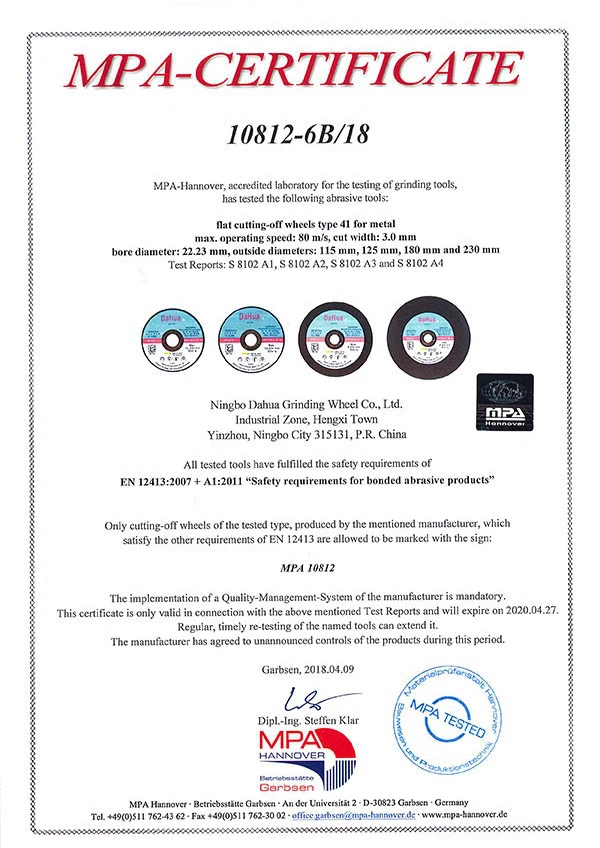
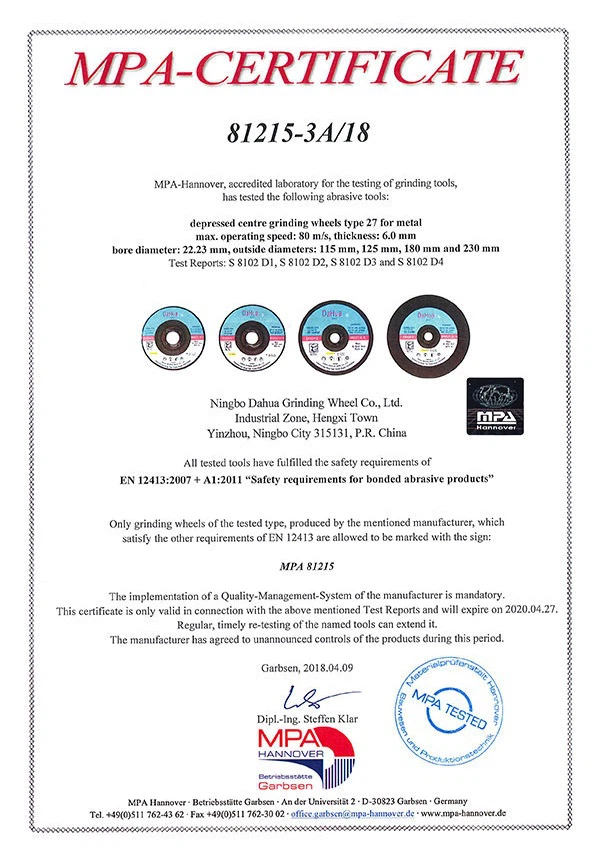
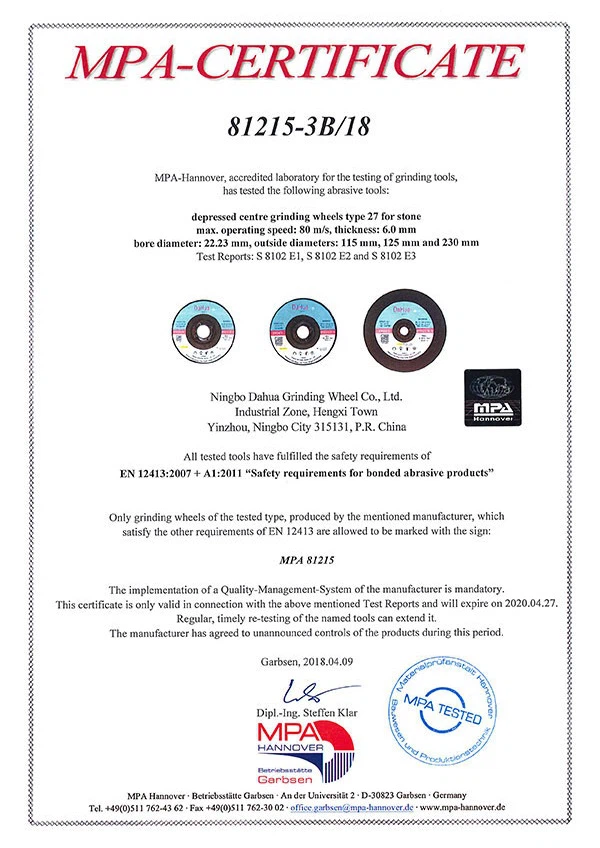
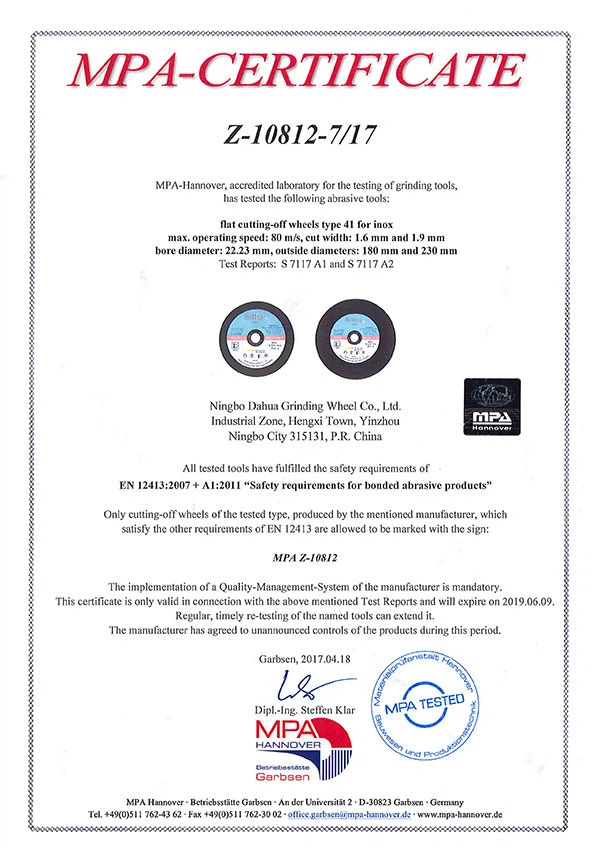
Ningbo Dahua Grinding Wheel Co.,Ltd. Is a well known Chinese company specialized in Researching and producing resin abrasive products. It was found in 1996, mainly produce fiber reinforced resin cutting and grinding wheel, rail cutting and grinding wheel, ordinary resin grinding wheel, fiber glass etc. The factory has Industrial Production License and Independent Exporting License. In the past 20 years, it sales to more than 70 countries in the world and the quality of products is universally recognized.
The company passed ISO9001 Quality Management System and has perfect quality assurance system. The equipment are all advanced and reliable. Also, it has perfect raw material inspect, finished product inspection center and quality assurance team to assure the stability of products.
The company awarded National high-tech enterprises in 2012 and awarded Provincial Engineering Technology Center in 2017. It has more than ten Independent intellectual property invention patent and professional R&D team to provide technical support to offer suitable product to the customers. Based on many years accumulation of industrial insight, produce experience, innovate ability and service network in abrasive industry, the company can not only offer high quality customized products, but also study, design and choose new material for new products together with other factory.
The company will go on struggle as always, renew and improve the quality of products constantly, maintain good services and competitive prices. Warmly welcome you to negotiate cooperation and create better business value.

Our Certificate


FAQ
Q: What is cutting wheel?
A: Cutting wheels (aka cut-off discs) are an abrasive tool used for fast cutting of materials like metal, concrete, and stone. Their portability allows the operator to move around freely with it and maneuver their tools from different angles to easily cut a material.
Q: What is a cutting wheel used for?
A: Cutting wheels, or cutting wheels, differ from grinding wheels in their function and structure. Where grinding wheels use an abrasive to grind large pieces of material off a workpiece from a shallow angle, cutting wheels typically make narrow, precise cuts at 90-degree angles.
Q: What are cutting wheels made of?
A: High-quality cutting discs are made of resinoid-bonded abrasives. The bonding agent, resinoid, holds the wheel and the abrasive material together. As it wears away through use, fresh sharp grains are exposed to continue cutting to extend the long life of the product.
The most commonly used abrasives embedded in the resinoid wheels are aluminum oxide and silicon carbide.
Reinforced cutoff wheels are the most durable cut wheels. They are reinforced with fiberglass to provide extra strength to last long and avoid breaking from extra pressure forced on it.
The most commonly used abrasives embedded in the resinoid wheels are aluminum oxide and silicon carbide.
Reinforced cutoff wheels are the most durable cut wheels. They are reinforced with fiberglass to provide extra strength to last long and avoid breaking from extra pressure forced on it.
Q: Is it safe to grind with a cutting wheel?
A: No! Cutting-off wheels are for cutting on the periphery only. Cutting-off wheels are thin by design and do not have adequate lateral strength for side grinding.
Q: What is the difference between grinding wheel and cutoff wheel?
A: Cutting wheels or cutting wheels have different applications and structures than grinding wheels. cutting wheels cut small material workpieces at 90-degree angles, whereas grinding wheels grind large material workpieces from a low angle. As a result, cutting wheels are quite thinner than grinding wheels.
Q: Can a cutting wheel cut wood?
A: First of all, you should never cut wood with regular angle grinder cutting discs.
Q: Can a cutting wheel cut stainless steel?
A: It is essential to choose a cutting wheel made from abrasives compatible with stainless steel to ensure the workpiece isn't contaminated. The right cutting wheel for stainless steel will increase efficiency, reduce rework and eliminate cross-contamination.
Q: Why do cutoff wheels break?
A: Improper machine conditions. Loose wheel spindle, excessive end play, and loose or vibrating machine parts such as the work-table and the work holder may cause the wheel to bend in the cut and break.
Q: What thickness cut off a wheel?
A: Wheel thickness is the most important factor to consider while choosing the right cutting wheel. For general purpose cutting of stainless or mild steel choose a 1mm or 1.6mm thick wheel. For cutting through hard metals choose standard thin 0. 045 inch & ultra-thin 1 mm cutting wheels.
Q: Can you put cutting wheels on angle grinder?
A: For flat cutting discs, mount the flange with the flat side towards the wheel. Use the key or wrench to fix tightly to the grinder. Once the wheel is in place, it should not move or rotate. Take care not to over tighten the flange, this might damage the disc and make it hard to remove the stub when you're finished.
Q: What is the difference between 40 grit and 60 grit cutting wheel?
A: Typically, 40 grit is used for grinding metal quickly, 60 grit will provide good stock removal but with a smoother finish and 80 grit is better for shaping and light stock removal. Diamond blades are a popular choice for use with angle grinders.
Q: Do cutting wheels expire?
A: Cutting wheels should be replaced when they hit their expiration date. This can be found imprinted on the metal center of the disc. Time, UV light, changes in temperature, humidity, and other storing conditions cause the bonding agents that keep the disc together to break down.
Q: What shouldn't you do with a cutting wheel?
A: Never grind with a cutting wheel: A cutting wheel doesn't have the fiberglass reinforcement that a grinding wheel does, so it can be dangerous to grind with a cutting wheel. Only use a cutting wheel for cutting. Combination wheels can be used for cutting and grinding and are marked accordingly.
Q: How many types of cutting wheels are there?
A: Cutting wheels come in a few different types. Some common types are type 1, type 27, type 41, and type 42, where the various numbers signify the wheels' different shapes and properties.
Q: Can you use a cutting wheel on masonry?
A: Cutting wheels contain either zirconia or aluminum oxide, depending on their intended use. Silicon-carbide abrasive particles are sharper and harder, and thus continue cutting efficiently on concrete or other masonry surfaces.
Q: How do you store cutting wheels?
A: Thin organic bonded wheels, such as those used for cutting off, should be laid flat on a flat steel surface or similarly rigid material away from excessive heat, moisture, and other liquids to prevent warpage. Loose blotters should not be placed between stacked thin wheels.
Q: Can you sand with a cutting wheel?
A: Angle grinders are a multi-use sanding tool that are compatible with a wide range of wheels and discs, including resin fiber discs, overlap discs, cutting wheels, grinding wheels, and much more. This allows for several different types of sanding applications!
Q: How do you use a cutting wheel?
A: When using a cutting wheel, we recommend using a two handed golf like grip to hold and guide the tool and go for a right angle. If you angle the wheel in the cut, the wheel will probably break.
Q: Can cutting wheels be used to grind material?
A: Using a cutting wheel for side grinding can have serious consequences. The photographs seen here show what can happen to a cut-off wheel when the side is used for deburring or grinding. The workpiece can cut through the reinforcing side fiberglass weakening the wheel. This may result in wheel breakage and injury.
Q: What is the difference between a type 1 and a type 27 cutting wheel?
A: Type 1 grinding wheels are flat and used for a variety of grinding and cutting tasks on flat surfaces, edges, and angles. Type 27 grinding wheels have a saucer shape with a depressed center, making them ideal for grinding and cutting on contoured surfaces and hard-to-reach areas.
We're professional cutting wheel suppliers in China, specialized in providing high quality products and service. We warmly welcome you to buy high-grade cutting wheel made in China here from our factory. For quotation and free sample, contact us now.
4 Inch Diamond Cutting Wheel, Cutting Wheel 6 Inch, 4 Diamond Cutting Wheel